Outcomes from INVERT: A Risk-Based Tool Against Labour Exploitation
Labour exploitation has emerged as predominant purpose of human trafficking in Europe. A recent report from the European Commission revealed that the proportion of victims of human trafficking subjected to labour exploitation doubled between 2008 and 2023, now exceeding 40% of identified cases. During a recent meeting organised by Transcrime at the Public Prosecutor’s Office of Milan, the Italian National Anti-Trafficking Network confirmed this shift: due to the prevalence of male workers in labour exploitation, the share of detected male victims rose from 13% in 2017 to 52.2% in 2025.
This expansion particularly affects sectors where subcontracting, transient workforces and low-skilled labour are endemic, such as agriculture, logistics, manufacturing and fashion. This is fuelled by multi-tiered supply-chains in which large clients outsource production through networks that combine bona fide suppliers with buffer and shell companies aimed at obscuring forced labour.
Rather than relying solely on reports from victims, which are often absent due to threats of reprisals or lack of awareness, the EU-funded project INVERT (https://invert-project.eu/) — coordinated by Transcrime — adopted a risk-based approach to enable proactive investigations. We examined how exploitation infiltrates supply chains, distilling risk factors and translating them into operational indicators. These were then implemented in the INVERT prototype suite and tested in pilot cases across Europe.
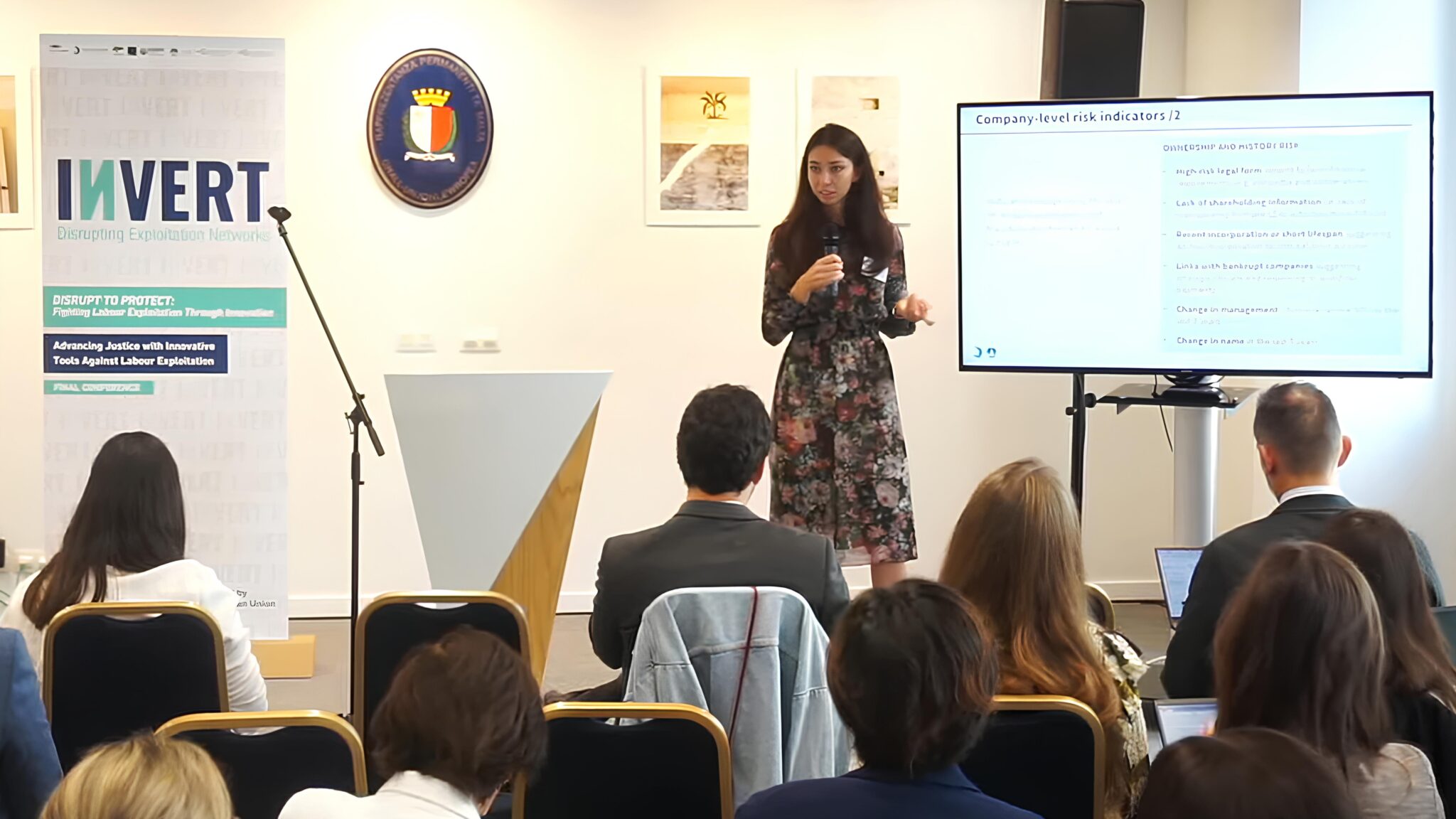
The results were presented at the project’s final conference in Brussels on 19 September 2025: a discussion with law enforcement agencies, NGOs, researchers, and policymakers.
Risk Indicators
The indicators are organised into two complementary sets, based on analyses of recurring patterns among both firms and victims.
Company-level indicators have been operationalised using machine learning techniques to assign risk area scores and flag entities potentially involved in exploitation. These can be grouped into three categories:
- Territorial and sectoral exposure – e.g., high-risk jurisdictions, labour-intensive sectors, unusual geographic clustering;
- Ownership and corporate history – e.g., opaque legal structures, lack of beneficial-owner information, recent incorporations, managerial turnover, links with bankrupt entities;
- Financial anomalies – e.g., extensive outsourcing, unusually low declared labour costs, absence of substantive economic activity.
Victim-level indicators aim to structure the professional assessment of potential victims across migration pathways, contractual and working conditions, debt and housing situations, control mechanisms, and signs of coercion or trauma. This module of the tool acts as a support device— guiding analyses and interviews while organising sensitive information. Given the sensitive nature of this procedure, it is not designed to assign automatic scores, enabling contextualised evaluation.
Tool functionalities
The INVERT prototype suite streamlines investigations into complex supply chains, converting large volumes of corporate and financial data into intuitive visual insights. It automates time-consuming tasks and facilitates access to public datasets, supporting more accurate decision-making without replacing the analyst. To this end, end users are trained in efficient and informed use. The interface has been designed for exploration of networks, corporate structures, financial flows, and geographic relationships, while breaking down risk areas to avoid “black-box” outcomes. Pilots conducted with law enforcement partners confirmed both the tool’s predictive capabilities and its practical value for proactive, risk-led targeting.
Interested potential end-users are invited to contact transcrime@unicatt.it for further information.
Latest news
View all news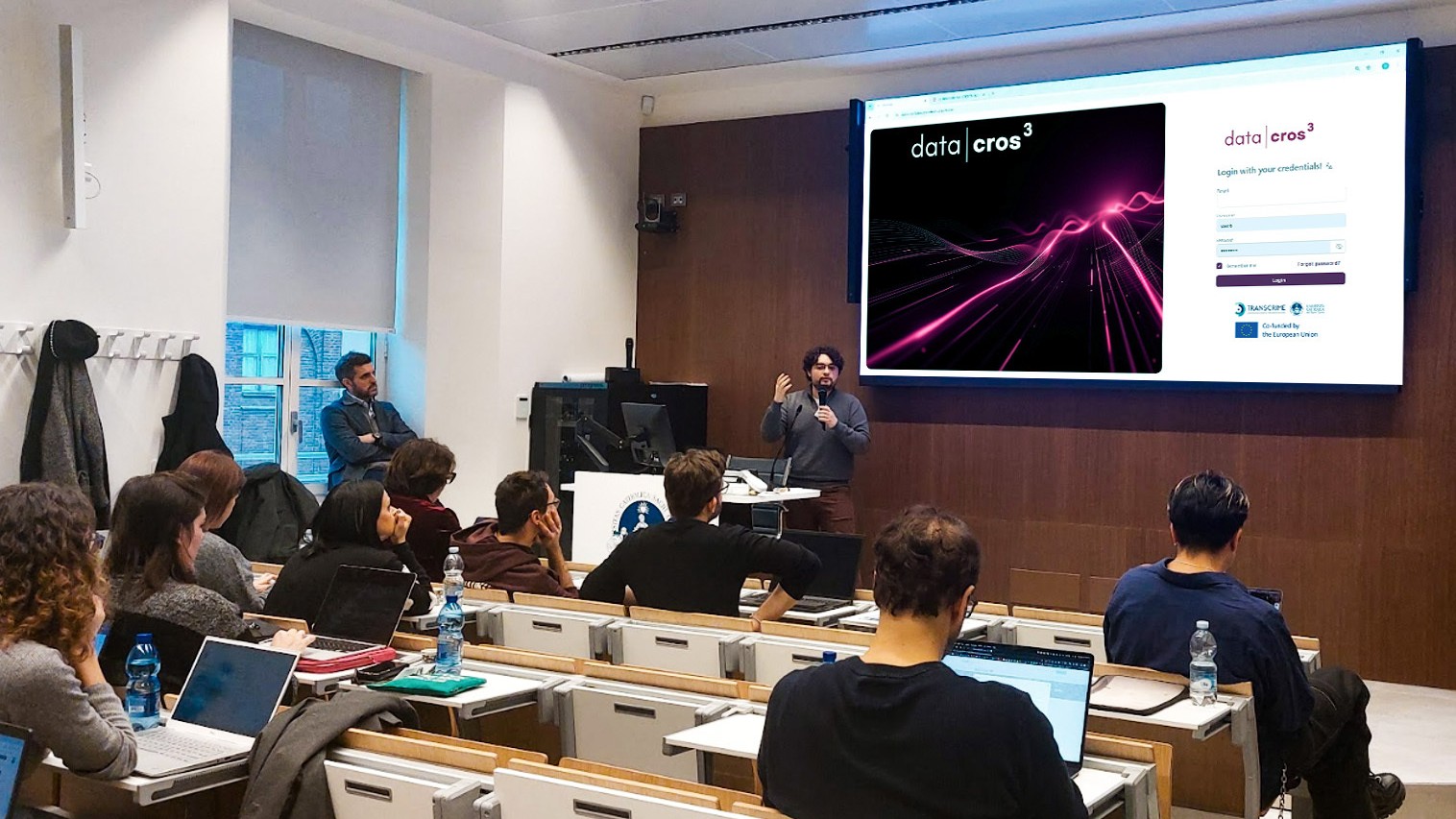
NEXT-IJ Investigathon: technologies and AI for investigative journalism
The effectiveness of investigative journalism is a barometer of a healthy democracy, strengthening transparency around power and economic interests. Yet, to trace connections and document facts, journalists increasingly need new skills and tools to unravel complex, transnational criminal patterns. To support them in this challenge, the Università Cattolica hosted the three-day…

TENACITy: a new report and tools to investigate the abuse of transport systems
The new report “Preventing the misuse of commercial aviation: Using passenger data to identify high-risk passengers and emerging threats” provides a high-level overview of the research activities carried out by Transcrime within the Horizon Europe-funded project TENACITy (Travelling Intelligence Against Crime…

A conference in Italian on integrity measures in a major public project
A conference in Italian will be held on 3 December 2025 at Università Cattolica (Milan) to present the first empirical study in Italy on integrity controls in a major infrastructure project: the construction of Milan’s Blue Metro Line. Conducted by Transcrime, its spin-off Crime&tech, and Metro4…

Transcrime at the 2025 ASC Conference
“Criminology, Law, and The Democratic Ideal” 12–15 November 2025 – Washington, D.C. – Marriott Marquis This year’s American Society of Criminology conference reflects on how criminological research contributes to the reinforcement of the rule of law and democratic accountability. A shared ambition across all EU-funded…

Prevent and Detect – DATACROS III Training
“How to early-detect organised crime infiltration, corruption and fraud: red-flags and best practices” 14 November 2025 | 10.30 – 16.30 CETWebinar on Webex Public procurement, local authorisations, and service contracts are prime targets for organised crime, channeling substantial financial flows and offering long-term influence…

Kick-off Meeting of SECURE: Strengthening the Rule of Law against Corruption
Corruption is a powerful driver of organised crime within the European Union, and the exposure of Member States has been highlighted by recent scandals. According to Europol’s recent report, today over 70% of the EU’s major criminal networks currently rely on corruption to move illicit assets, misappropriate public funds…