Ceasefire Virtual Kick-Off Meeting
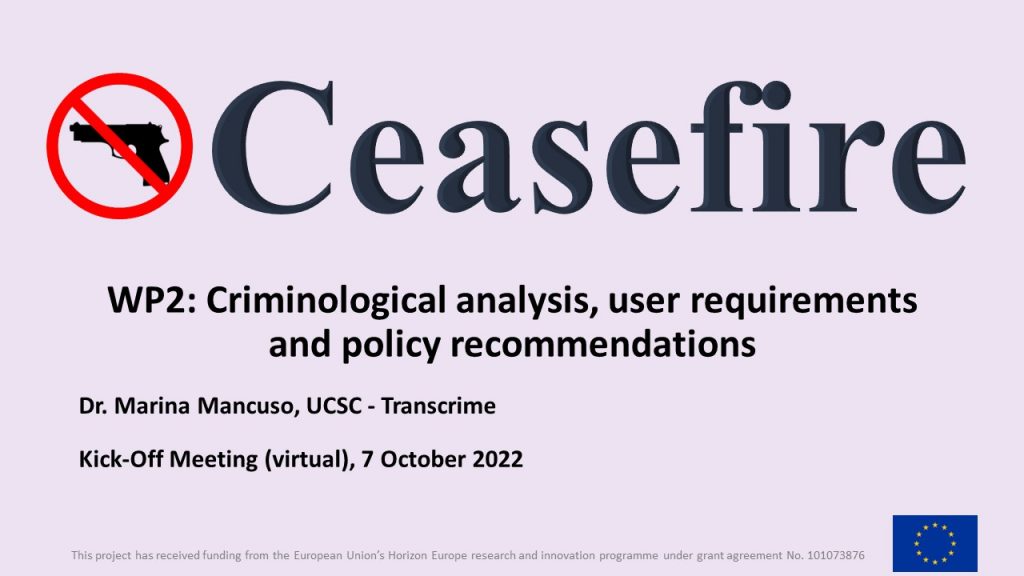
On Friday 7th of October, we joined the virtual Kick Off Meeting of Ceasefire – Advanced versatile artificial intelligence technologies and interconnected cross-sectoral fully-operational national focal points for combating illicit firearms trafficking (GA N. 101073876), a project funded by the European Commission within the Horizon Europe Programme.
This project, that will last till September 2025, aims at increasing LEAs abilities to detect, analyze and track activities related to cross-border illicit firearms trafficking through two main activities.
Firstly, the development of advanced Artificial Intelligence (ΑΙ) technologies to facilitate the activities of relevant actors, and secondly the establishment of fully-operational National Firearms Focal Points (NFPs), to reduce currently existing organizational, operational, legal, cooperation and information exchange challenges.
The meeting provided also the opportunity to discuss with the Project Coordinator, Centre for Research and Technology Hellas (CERTH), and the other 19 partners future activities and tasks.
During this project, Transcrime research team, leader of Work Package 2, will focus on: 1) analyzing the most recent modi operandi and trends in firearms trafficking, and 2) managing one of the five use-cases of the project, i.e. the one related to the development of a near real-time firearms incidents tracking tool.
Latest news
View all news
#TranscrimeFiles | The new architecture of labour exploitation
Global supply chains and inadequate migration policies have created new vulnerabilities for the fastest-growing, yet least-studied driver of human trafficking: labor exploitation. Its new and complex architecture exploits layered networks of seemingly legitimate firms to evade scrutiny, presenting severe challenges to traditional law enforcement. Within the EU-funded projects VANGUARD…

Transcrime agenda at the XXVI ESC Annual Conference
Frontiers of Criminology 9-12 September 2026 – Warsaw, Poland At the Eurocrim 2026 Conference, Transcrime researchers will present more than twenty recent studies in which we investigated markets’ vulnerabilities to criminal infiltration, organised crime structures and modi operandi, and risks to…

#TranscrimeFiles | A case of EU funds fraud unmasked through the Risk Visioner tool
Watch how a real EU funds fraud, engineered to withstand scrutiny, was exposed through data-driven risk assessment, network analysis and AI screening modules run end-to-end within our tool Risk Visioner – developed by Transcrime and Crime&tech within the EU-funded project DATACROS III.

EJCPR ranked 9th worldwide in the field of criminology
The European Journal on Criminal Policy and Research (EJCPR) has been ranked 9th worldwide in the Criminology & Penology category of the latest Journal Citation Reports (JCR), one of the leading international rankings of academic journals. This places the EJCPR in the first quartile (Q1), recognising it among the…

Inside the Corruption Maze: Data-led Strategies to Investigate Corruption
Training session under the EU co-funded project SECURE 18 June 2026 | h. 10:00 – 14:00 CEST Online, via Webex Public authorities, law enforcement agencies and journalists face a paradox: while data is more abundant than ever, information fragmentation and saturation are capitalized upon by…

Integrity & Due Diligence – 3rd DATACROS III Training
“Identifying criminal red flags in AML Due Diligence for high-risk customers and supply chains” 24 June 2026 | 9:45 – 13:00 CEST Online, via Webex Criminal organisations are becoming highly adaptive economic actors, capable of embedding themselves into legitimate markets, supply chains, financial flows and service…