NEXT-IJ Investigathon: technologies and AI for investigative journalism
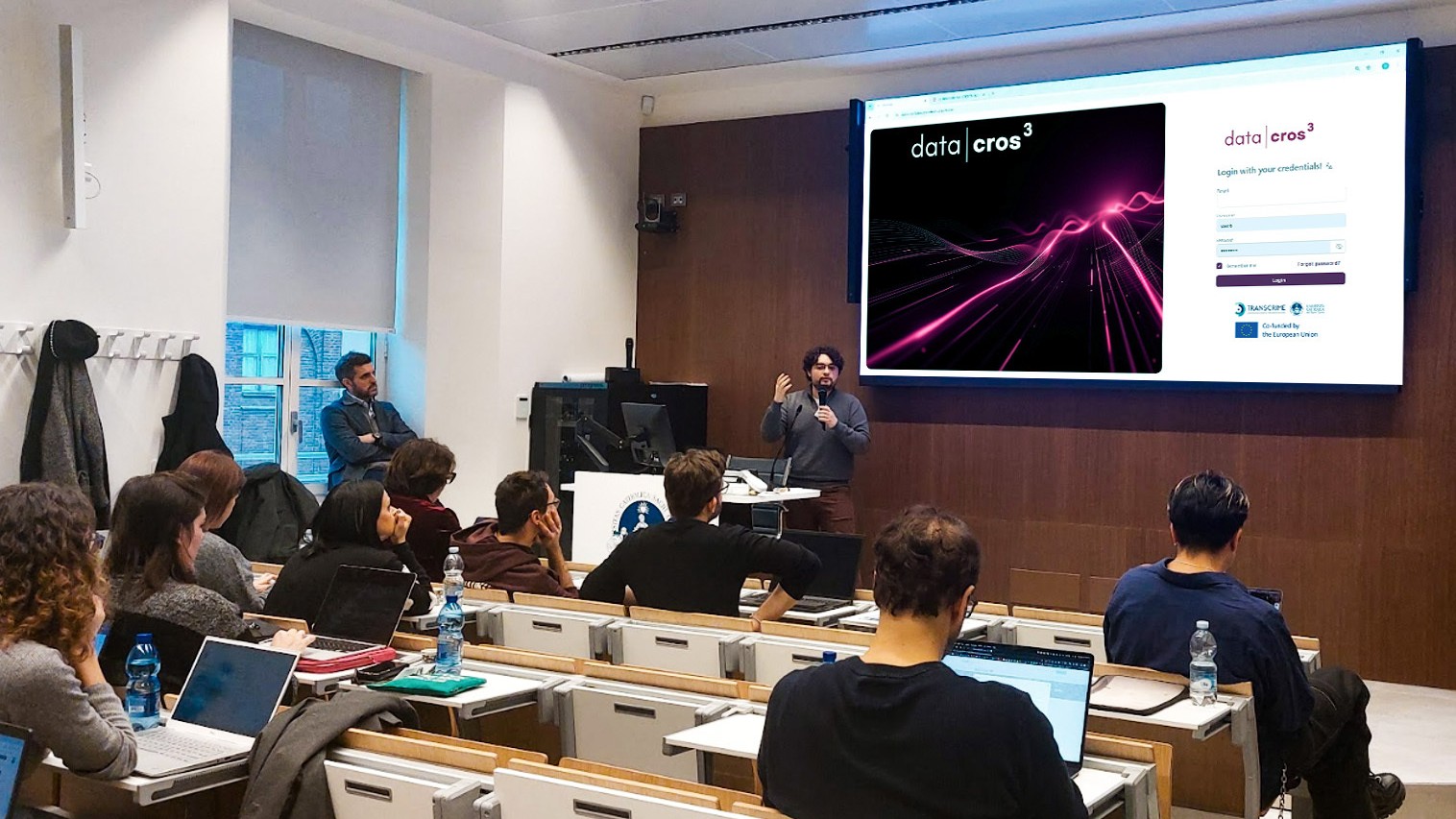
The effectiveness of investigative journalism is a barometer of a healthy democracy, strengthening transparency around power and economic interests. Yet, to trace connections and document facts, journalists increasingly need new skills and tools to unravel complex, transnational criminal patterns. To support them in this challenge, the Università Cattolica hosted the three-day Investigathon “Uncovering the Story” as parte of the European project NEXT-IJ, organised by the research centre Transcrime and the School of Journalism of the University, the Organized Crime and Corruption Reporting Project – project coordinator – and the Global Forum for Media Development.
Over 30 journalists from 18 European countries, working alongside students from the School of Journalism, were trained in the use of advanced investigative tools such as DATACROS, developed by Transcrime, and OCCRP’s Aleph. These tools were then used by working groups to develop investigative ideas, gather and analyse data from sources such as company and property registries, financial data, sanctioned entities, politically exposed persons, news, journalistic leaks, and satellite images.
With Transcrime’s guidance on adopting a ‘data-driven’ and ‘risk-based’ investigative approach, participants identified promising leads on: suspicious concentrations of short-term rental properties in major European cities, potentially linked to high-risk individuals; illicit exchanges of surveillance technology between Europe and sanctioned countries via satellite jurisdictions and intermediaries; and the interests and beneficiaries behind the opaque trade in pseudo medicine and health products.
The use of DATACROS enabled and simplified complex tasks of lead research and verification, reconstructing ownership chains and links between entities, assessing their exposure to risk through Transcrime’s AI models, identifying news and leaks, and testing a new NLP (Natural Language Processing) module for online news scraping.
“What stands out about DATACROS is the speed and versatility of its searches. It enables you to maximise efforts that would otherwise be scattered across multiple sources, and its value is even clearer when managing the extracted data,” said Mauro Meazza, journalist at Il Sole 24 Ore and Lecturer at Università Cattolica’s School of Journalism. According to Gabriele Cruciata, investigative journalist and author of Poche Storie, “the ability to cross-reference data from various databases in one place – sometimes difficult to access on their own – makes DATACROS an extremely practical tool for mapping money movements, connections between people and companies, and business relationships. It allows information that might otherwise remain isolated to be properly contextualised and given meaning.”
The most promising investigation will be developed into a full reportage within the NEXT-IJ project – funded by the European Commission – as evidence of the impact of this collaboration between research institutions and one of the largest global networks of investigative journalism. In this context, Transcrime contributes its investigative and technological know-how to strengthen the skills of European newsrooms and integrate global data and advanced analytics tools.
Journalists interested in the tools and activities of the projects can visit https://hub.next-ij.eu/ and https://www.datacros3.com/
Latest news
View all news
DATACROS III International Conference
12 November 2026 9.30 – 17:00 EET (8.30 – 16:00 CET) Bucharest and Online Like any modern enterprise, criminal organisations have proved highly responsive to emerging opportunities: exploiting technologies such as AI and crypto to reduce costs, scale operations and launder proceeds; targeting new markets,…
Governance transition at Transcrime, marked by continuity and international growth
On Tuesday 22 September 2026, the Executive Board of Transcrime – Joint research centre on innovation and crime of Università Cattolica del Sacro Cuore, Alma Mater Studiorum University of Bologna and Università di Perugia – elected Prof. Michele Riccardi as the Centre’s new Director. The outgoing Director, Prof. Ernesto U.

#TranscrimeFiles | The new architecture of labour exploitation
Global supply chains and inadequate migration policies have created new vulnerabilities for the fastest-growing, yet least-studied driver of human trafficking: labor exploitation. Its new and complex architecture exploits layered networks of seemingly legitimate firms to evade scrutiny, presenting severe challenges to traditional law enforcement. Within the EU-funded projects VANGUARD…

Transcrime agenda at the XXVI ESC Annual Conference
Frontiers of Criminology 9-12 September 2026 – Warsaw, Poland At the Eurocrim 2026 Conference, Transcrime researchers will present more than twenty recent studies in which we investigated markets’ vulnerabilities to criminal infiltration, organised crime structures and modi operandi, and risks to…

#TranscrimeFiles | A case of EU funds fraud unmasked through the Risk Visioner tool
Watch how a real EU funds fraud, engineered to withstand scrutiny, was exposed through data-driven risk assessment, network analysis and AI screening modules run end-to-end within our tool Risk Visioner – developed by Transcrime and Crime&tech within the EU-funded project DATACROS III.

EJCPR ranked 9th worldwide in the field of criminology
The European Journal on Criminal Policy and Research (EJCPR) has been ranked 9th worldwide in the Criminology & Penology category of the latest Journal Citation Reports (JCR), one of the leading international rankings of academic journals. This places the EJCPR in the first quartile (Q1), recognising it among the…