Illicit financial flows and the impact on developing countries
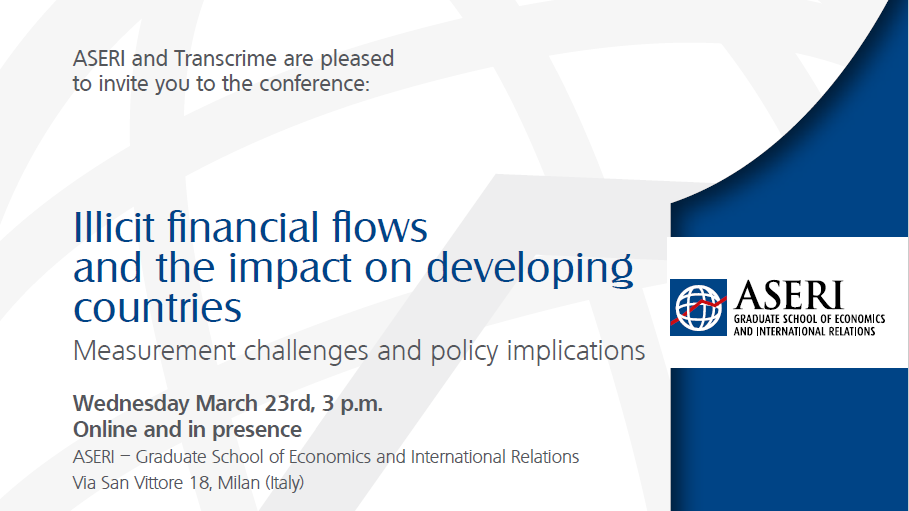
Transcrime and ASERI are pleased to announce the “Illicit financial flows and the impact on developing countries: Measurement challenges and policy implications” conference, which will take place on March 23rd, at 3 p.m.
The event will be joined by the Distinguished Professor Peter Reuter, from the University of Maryland, and will focus on the concept of Illicit Financial Flows (IFFs), which has become a key issue in the international agenda and lies at the core of the global debate.
Specifically, starting from the heavy impact that IFFs show to have on developing countries, the event will provide the chance to discuss the existing difficulties in the assessment and measurement of such phenomenon, and the challenges that this sets to the design of effective policies to curb it.
The event will be accessible both in presence at ASERI – Graduate School of Economics and International Relations (Via San Vittore 18, Milano) and online.
To join the event, register at the following links:
You can find out more in the Event agenda and in the Official Leaflet.
Event Structure
Keynote Speech:
- Peter REUTER, Distinguished Professor of Public Policy and Criminology at the University of Maryland
Roundtable:
- Alberto AZIANI, Assistant Professor at Università Cattolica del Sacro Cuore and Senior Researcher at Transcrime
- Simona BERETTA, Full Professor of International Economics at Università Cattolica del Sacro Cuore, Director of ASERI Master in International Cooperation and Development
- Mario A. MAGGIONI, Professor of Economics at the Faculty of Political Science of Università Cattolica del Sacro Cuore and member of the Managing Committee of Transcrime
Chair:
- Michele RICCARDI, Deputy Director at Transcrime and Adjunct Professor at Università Cattolica del Sacro Cuore and ASERI
Latest news
View all news
Transcrime agenda at the 2026 ASC Annual Conference
Criminology and Justice Policy 18-21 November 2026 – Chicago, IL, USA At the 81st Annual Meeting of the American Society of Criminology, Transcrime researchers will present recent studies on the vulnerabilities of legal economies and public institutions, how the presence of…

Football: opaque club ownership is more likely associated to higher financial and criminal risks
Who are the ultimate owners of Italian football clubs? Where does the money invested in these clubs come from? And what risks lie behind investment funds, fiduciary companies and transnational corporate structures that make it difficult to identify the individuals who ultimately control them? These questions are addressed by a…

DATACROS III International Conference
12 November 2026 9.30 – 17:00 EET (8.30 – 16:00 CET) Bucharest and Online Like any modern enterprise, criminal organisations have proved highly responsive to emerging opportunities: exploiting technologies such as AI and crypto to reduce costs, scale operations and launder proceeds; targeting new markets,…
Governance transition at Transcrime, marked by continuity and international growth
On Tuesday 22 September 2026, the Executive Board of Transcrime – Joint research centre on innovation and crime of Università Cattolica del Sacro Cuore, Alma Mater Studiorum University of Bologna and Università di Perugia – elected Prof. Michele Riccardi as the Centre’s new Director. The outgoing Director, Prof. Ernesto U.

#TranscrimeFiles | The new architecture of labour exploitation
Global supply chains and inadequate migration policies have created new vulnerabilities for the fastest-growing, yet least-studied driver of human trafficking: labor exploitation. Its new and complex architecture exploits layered networks of seemingly legitimate firms to evade scrutiny, presenting severe challenges to traditional law enforcement. Within the EU-funded projects VANGUARD…

Transcrime agenda at the XXVI ESC Annual Conference
Frontiers of Criminology 9-12 September 2026 – Warsaw, Poland At the Eurocrim 2026 Conference, Transcrime researchers will present more than twenty recent studies in which we investigated markets’ vulnerabilities to criminal infiltration, organised crime structures and modi operandi, and risks to…