The Future of the EU Fight Against Organised Crime: Takeaways from the DATACROS III Conference
DATACROS III is co-funded by the European Union
On 12 November 2026, more than 200 participants joined the DATACROS III Workshop and International Conference on Organised and Financial Crime in Bucharest and online (full programme here). The event was hosted by ANABI, the Romanian National Agency for the Management of Seized Assets, and organised with Transcrime – Università Cattolica del Sacro Cuore, the project partners and the European Journal on Criminal Policy and Research. The morning was a hands-on workshop on how organised crime is investigated today, including a live demonstration of the results and technologies developed within the DATACROS III project. In the afternoon, roundtables brought together European and global experts to discuss the future of the EU’s strategy against criminal phenomenon and corruption. The recording is available below.
Morning workshop: investigative needs and technological solutions
The conference opened with remarks from ANABI, Transcrime and the European Commission (DG HOME), tracing DATACROS’ development since 2019. The project now involves more than 20 organisations from 13 countries, including law enforcement agencies, asset recovery offices, financial intelligence units, anti-corruption, transparency and competition authorities, research centres, investigative journalists and private firms. Together, they have designed, developed and tested the tool in real international investigations. ANABI highlighted the platform’s contribution in Romania, where it has expanded confiscation capacity and strengthened cooperation between domestic authorities as well as international partners. Before DATACROS, many asset recovery offices lacked adequate, affordable tools. Developed around the needs of its users, the platform helps close this gap by accelerating the cross-border tracing of assets and their owners.
Bart Swennen, financial investigator at the Belgian Federal Police, outlined the challenges facing investigators: hundreds of terabytes of data spread across countries and continents, tight deadlines, shell companies that change faster than they can be detected, complex VAT and customs fraud, and increasingly sophisticated trade-based money laundering. In this framework, he compared his unit’s work “before and after DATACROS” with the tool bringing forth a new paradigm. Previously, investigators had to search registers country by country, while much of the most useful data was behind paywalls. Now, a single web-based, GDPR-compliant platform brings relevant sources together and maps the ownership of dozens of companies and individuals in moments, providing an overview of criminal networks, flagging risks involving companies, crypto wallets, real estate and public contracts, reducing search times and false positives and helping law enforcement act more proactively.
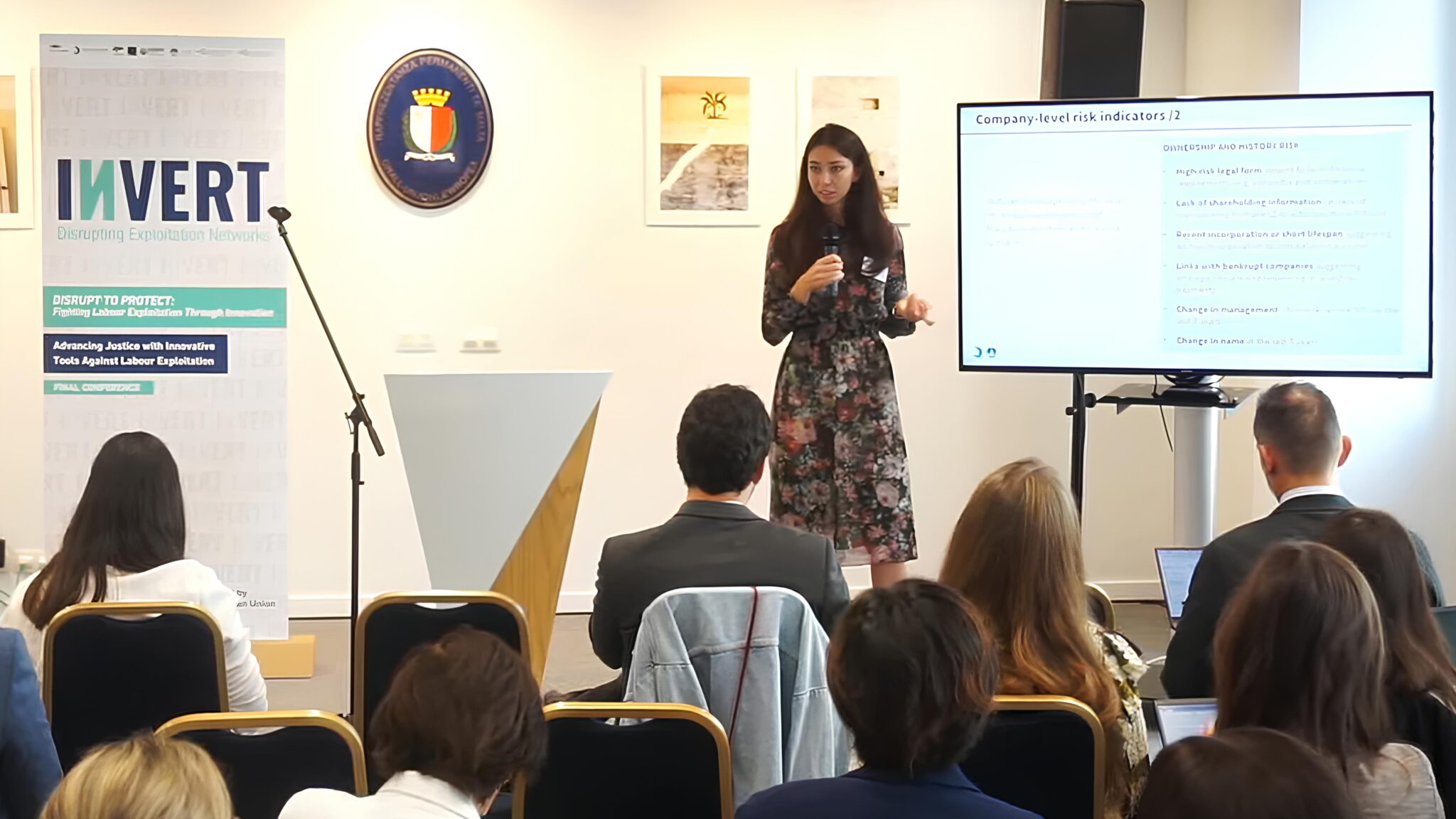
Michael Lo Giudice (Transcrime) demonstrated the platform live, explaining the risk indicators used to assess companies and individuals. These feed an automated scoring system, scientifically validated and tested with end users, which can be broken down by risk area, covering ownership structures, territorial and sectoral risks, political exposure, financial anomalies, negative events and countermeasures, among others. Based on a real fraud case, he provided a demonstration of de tool, deconstructing the network of companies and individuals involved and identifying the ultimate beneficial owners of EU public funds. He also showed the new AI screening module, which automatically collects, interprets and summarises open-source information, classifying results by risk level and typology while respecting the GDPR.
Afternoon roundtables: the future of the EU strategy
The afternoon widened the focus from tools to policy. Speakers from OCCRP, Transcrime, the European Commission (DG HOME) and the European Journal on Criminal Policy and Research discussed the growing overlap between criminal networks and political spheres, once largely separate. For OCCRP, counting arrests, convictions and seizures fails to capture this broader criminal continuum, leaving much of the wealth and influence untouched. The European Commission described how criminal networks increasingly offer crime as a service, penetrate the legal economy and exploit technology, often taking advantage of crises and fast-track emergency funding. For this reason the security priorities should focus on following the money and targeting those who enable criminal activity, through a new EU framework on organised crime, stronger asset recovery powers and guidance on the use of administrative measures.
Speakers from RE-ACT, Dublin City University and the Basel Institute on Governance highlighted the opportunity for Europe to take a leading role in promoting integrity as others step back. The new EU anti-corruption directive and forthcoming strategy aim to move beyond formal compliance towards anticipating risks. As a DATACROS partner, RE-ACT attested potential in the platform’s technologies for public procurement officers, who are increasingly required to conduct risk due diligence. Training sessions with public bodies have indeed generated strong interest. Three obstacles remain: incomplete data availability, limited time and expertise within administrations, and the legal difficulties of excluding a bidder on the basis of a warning sign. Tools such as DATACROS may increasingly become part of the investigative and prevention teams, while keeping the human-in-the-loop.
Then, speakers from Crystal Intelligence, IrpiMedia, GLEIF and the Astana Financial Services Authority discussed how to enforce sanctions when the people they target hide behind ever-changing companies and names. Sanctioned individuals can escape restrictions quickly and cheaply, which is why the EU’s latest sanctions package aims to target the networks that support them. This means looking behind companies’ formal owners, which is what IrpiMedia did with DATACROS. By screening around 900 companies in a single sector, its journalists found sanctioned owners among the beneficiaries of EU public funds, hidden behind offshore chains and intermediaries. Since authorities can check only a few hundred of the millions of beneficiaries of public funds each year, tools that screen large amounts of data quickly are essential to show where closer checks are needed.
The final roundtable showed how DATACROS supports the operational work of different end users, with speakers from ANABI, DIICOT, EBRA and Context.ro. ANABI presented several recent cases, including a confiscation order, an embezzlement case by an organised crime group, and a large fraud. In each case the tool linked suspects, assets and companies across EU and non-EU jurisdictions, exposed nominee directors of companies and multiple firms registered at one single address, and led to bank accounts and properties abroad. Overall, in about 30% of requests that initially had no evident foreign element, DATACROS revealed a link with another country, making searches faster and requests for data access successful – leading to a 20–25% increase in asset-tracing capacity. For DIICOT, this makes cooperation with ANABI even more effective in freezing assets in time. Since beneficial ownership data are still poorly connected across Europe, EBRA noted, DATACROS’s ability to bring them together in a single platform makes a real difference. Context.ro confirmed it: for journalists, who must back every finding with evidence that holds up in court, DATACROS was key to an investigation into EU-funded public contracts that later led to an official inquiry.
Finally, Europol closed the day by presenting its tools for cross-border asset recovery and public-private cooperation. It described itself as a hub that links investigations across Europe and helps follow the money, providing information that national authorities could not reach on their own, in line with DATACROS.
Organisations interested in a demo of the tool can contact transcrime@unicatt.it